Skip to content


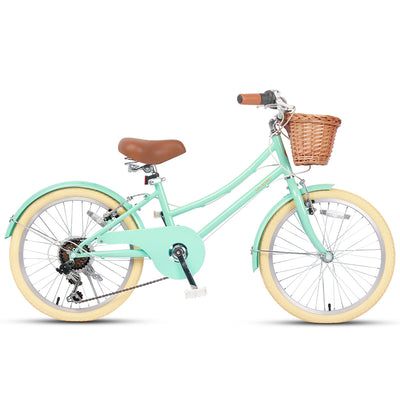


Table of Contents
Most 6-year-old girls fit a 16-, 18-, or 20-inch girls bike, but age alone should not decide what you buy. Your daughter’s height, inseam, and riding confidence will show whether she needs a smaller, easier-to-control bike or is ready for 20-inch wheels. This guide will help you measure her, compare sizes, and choose a bike that fits now while leaving reasonable room to grow.
Start With a 16, 18, or 20 Inch Bike
Kids’ bikes are sized by wheel diameter, not frame size. Age narrows the search, but height, leg length, and confidence settle the fit. These current Glerc ranges are a starting point; always check the exact bike before ordering.
|
Wheel size |
Current Glerc rider-height range |
Usually works best for |
Important fit note |
|
16 inches |
About 38–53 inches, depending on model |
Smaller riders and children still learning |
Many models include removable training wheels |
|
18 inches |
About 41–55 inches, depending on model |
Riders between common 16- and 20-inch sizes |
Offers more room without the full length of a 20-inch bike |
|
20 inches |
About 48–61 inches on common girls models |
Taller, confident, independent riders |
Many models do not include training wheels |
Measure Her Before Choosing a Size
 Before shopping, take your daughter’s current height and inseam measurements and compare them with our kids bike size guide. Height helps you narrow down the wheel size, while inseam gives you a better idea of whether she can stand over the frame, reach the ground, and manage the bike at its lowest saddle setting.
Measure Her Height
Have your daughter remove her shoes and stand straight against a wall with her heels on the floor. Place a hardcover book flat on top of her head, mark where it meets the wall, and measure from the floor to the mark. Record the result in inches so you can compare it directly with Glerc’s U.S. size charts.
Measure Her Inseam
Ask her to put on the sneakers she will normally wear while riding and stand with her feet about six inches apart. Hold a book between her legs with its spine facing upward to represent the bike saddle, then measure from the floor to the top of the book. This riding inseam is more useful than a pants inseam because it more accurately reflects how she will fit over the bike.
Check the Exact Model’s Fit Range
Do not rely on wheel size alone. Two 18-inch bikes can have different frame heights, minimum saddle settings, and distances between the seat and handlebars. Compare both measurements with the size chart for the exact model you are considering. If your daughter fits two sizes, choose based on her current riding ability rather than automatically buying the larger bike for extra growing room.
Choose Between 16, 18, and 20 Inch Bikes
Six is often a transition age rather than a single-size age. The smaller option usually favors immediate control, while the larger option demands more height and stronger riding skills.
Choose 16 Inches for a Smaller or New Rider
 A 16-inch bike often suits a girl near the lower height range or one who still needs help starting and stopping. Its shorter wheelbase and lower size can make tight turns and quick foot-down stops easier. It is also practical when she still uses training wheels.
Choose 18 Inches for an In-Between Fit
An 18-inch bike fills the gap when 16 inches looks cramped but 20 inches feels long or heavy. The Glerc Little Miss fits riders about 38–50 inches in the 16-inch size, 41–54 inches in the 18-inch size, and 48–60 inches in the 20-inch size. These overlaps let current control break the tie.
Choose 20 Inches for a Taller, Confident Rider
Consider 20 inches when she is about 48 inches or taller, fits the model’s range, and rides without support. She should brake, turn slowly, and put a foot down quickly. Extra frame length and weight are poor tradeoffs for another year of theoretical use.
Confirm She Can Control the Bike
Measurements can narrow down the options, but watching your daughter ride is the best way to confirm the fit. Have her test the bike on a flat driveway, an empty parking lot, or another open area away from traffic.
Check Standover and Ground Reach
Ask her to stand over the top tube with both feet flat on the ground. She should have comfortable clearance above the frame and be able to get on and off without catching her leg. A beginner may feel more secure with the saddle low enough to place both feet on the ground. You can raise it gradually as her balance and stopping skills improve.
Check Handlebar and Brake Reach
Her shoulders should look relaxed, with a slight bend in her elbows. She should not have to lean forward or lock her arms to reach the grips. Ask her to squeeze each brake lever while keeping her hands in their normal riding position. If she cannot operate the brakes comfortably after adjustment, try a different size or model.
Test Starts, Turns, and Stops
Let her start without you holding the saddle, ride in a straight line, turn in both directions, and stop at a chosen mark. Look beyond whether she can keep the bike moving. Repeated wobbling, unusually wide turns, dragged feet, or delayed stops may mean the bike is too large, too heavy, or difficult for her to control.
Choose Brakes, Gears, and Training Wheels for Her Skill Level
For riding around the neighborhood, on a flat driveway, or along paved park paths, a single-speed bike keeps things simple. A coaster brake lets your daughter stop by pedaling backward, while a front hand brake helps her practice the braking method she will use on larger bikes. Before buying, make sure she can comfortably reach and pull the lever.
Training wheels should reflect her balance skills, not simply her age. If she is still building confidence on two wheels, the 16- and 18-inch Glerc Petal provides removable training wheels along with a low step-through frame that makes getting on and off easier. Its coaster brake and front hand brake allow her to practice both stopping methods, while the basket, streamers, and doll seat make everyday rides more fun and personal.
FAQ
Do Girls Bikes Use a Different Sizing System?
No. Both use wheel-diameter sizing. Colors, accessories, and frame shapes may differ, but fit still depends on height, inseam, saddle range, reach, and brake access.
Can a Tall 6 Year Old Ride a 24 Inch Bike?
Occasionally, but 24 inches is not the usual size at age six. She must meet the model’s minimum measurements and pass every control test. Never lower a saddle beyond its marked safety limit.
How Much Growing Room Is Safe?
Use the saddle and handlebar adjustment range as a growing room. A good purchase fits safely at its lower settings and leaves room for later changes; an oversized frame does not.
Does Bike Weight Matter at This Age?
Yes. A heavy bike takes more effort to start, turn, and lift after a fall. Ask whether she can push it, hold it upright, and pick it up. Weight can decide between two otherwise suitable bikes.
How Long Will She Use the Same Bike Size?
Many children use one wheel size for several seasons, but growth varies. Recheck the fit when the saddle reaches its limit, her knees look cramped, or the handlebars feel too close. Prioritize confident control now with adjustment room for later.


GLERC creates stylish, durable kids bikes designed to help families ride together with confidence. From sizing guidance to assembly support, our team shares practical advice to make every ride safer and more fun.